
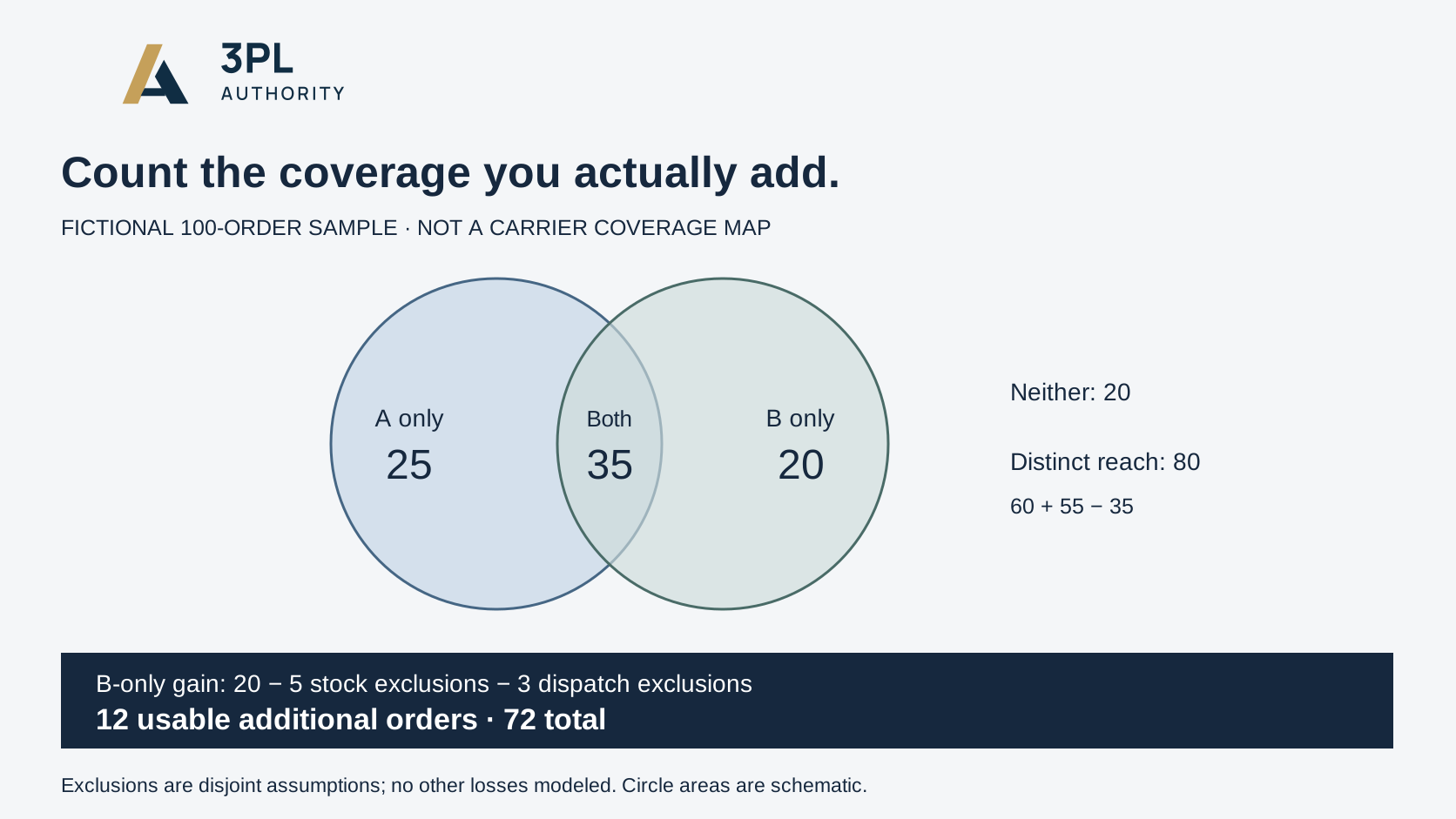
A second warehouse can add less reach than its map suggests. If both facilities serve many of the same customers within your target transit time, adding their percentages counts those orders twice. The relevant question is how many additional orders become serviceable under the proposed inventory and dispatch plan.
That distinction belongs in the shortlist stage. A network that looks broad on a presentation may still be a poor use of inventory if its incremental reach is small for your own demand.
Start with one order population
UPS describes its Ground transit maps as origin-ZIP-based illustrations of transit days. That makes the origin an input, not a universal promise for the whole network. Use current carrier tools for the actual service and dates; a map alone does not include your warehouse's processing delay or establish a delivery guarantee.
Build a destination sample from a defined period and keep the same orders in every candidate comparison. Separate orders with special service requirements rather than quietly treating them as ordinary ground parcels. Use anonymized destination information and retain the sample-selection method.
Calculate the overlap before the gain
We constructed a fictional 100-order sample to demonstrate the arithmetic. These counts are invented, not carrier map results or provider performance data.
| Group within the hypothetical transit target | Orders |
|---|---|
| Served by both origins | 35 |
| Served only by origin A | 25 |
| Served only by origin B | 20 |
| Served by neither | 20 |
Origin A covers 60 orders and B covers 55. Adding those figures gives 115, which is impossible as a count of distinct orders in this sample. Their union is 80: 60 plus 55 minus the 35 shared orders. Adding B to A therefore contributes 20 newly covered orders, not 55.
This is a set-counting exercise. It does not estimate any real network's reach. Its value is the question it forces a candidate to answer: which specific destinations improve, and which were already inside the target?
Apply the stock-and-dispatch gate
Now assume eight of the 20 B-only orders cannot actually use B: five lack the required stock and three miss the proposed dispatch window. These are disjoint fictional groups. With no other losses assumed, the usable gain is 12 orders, taking the modeled total from 60 to 72.
The eight excluded orders remain visible. They are not evidence that B is a bad warehouse; they identify the inventory placement and dispatch assumptions the business case must solve. A different stock policy could change the result, at a cost that needs its own calculation.
Ask for the marginal case
Request three outputs from each candidate: the current-origin result, the combined distinct-order result and the operationally eligible result. Keep carrier service, sample period and target definition consistent. If the second warehouse changes the order-routing rule, rerun the sample with that rule instead of choosing whichever origin looks best after the fact.
Then price the incremental benefit alongside extra stock, transfers and facility charges. Do not divide the entire network bill by the newly covered orders without deciding which costs are genuinely incremental. Equally, do not call a broader map a saving before evaluating those costs.
A second node earns its place through additional usable coverage for your customers. The overlap table makes that claim inspectable before the brand commits inventory.
Further reading
Use our 3PL selection guide to structure the shortlist and fulfillment pricing guide to compare the scope of work.
Sources
Research accessed 2026-11-16.
- https://www.ups.com/using/services/servicemaps/servicemaps.html
Research method and limitations
Constructed four disjoint fictional destination groups totaling 100; calculated union and marginal gain; applied two disjoint operational exclusions. No carrier tool simulation or real order sample. All examples and proposed controls are original editorial desk analysis. No interviews, surveys, firsthand provider testing or provider responses occurred. Unknown provider capabilities remain unknown.