
A reserved warehouse area can look reassuring on a tour. The commercial question is whether paying for that area improves the operation enough to justify paying for it when it is empty. Brands should separate three decisions: how much space they need, whether that space must be exclusive, and what service capacity accompanies it.
Those decisions can lead to different answers. A brand might need segregated stock without needing an entire dedicated facility. It might need guaranteed packing hours while its storage footprint remains modest. Ask candidates to price the requirement before choosing a facility model.
Define what is actually reserved
For this comparison, a dedicated-space offer means a fixed monthly charge for an agreed block of storage positions. A shared-space offer means a charge for occupied positions under a specified measurement rule. These are definitions for our analysis, not claims that every provider uses those terms consistently.
Request a diagram or location schedule describing the reserved area, usable positions, permitted product dimensions and access restrictions. Separately list receiving appointments, pick faces, packing stations and dispatch hours. A storage commitment does not, by itself, establish the terms for those other services.
The SBA's business-planning guidance distinguishes fixed and variable costs. We apply that distinction below to a warehouse-space decision; the SBA does not supply these rates or recommend either arrangement.
Model an entire occupancy year
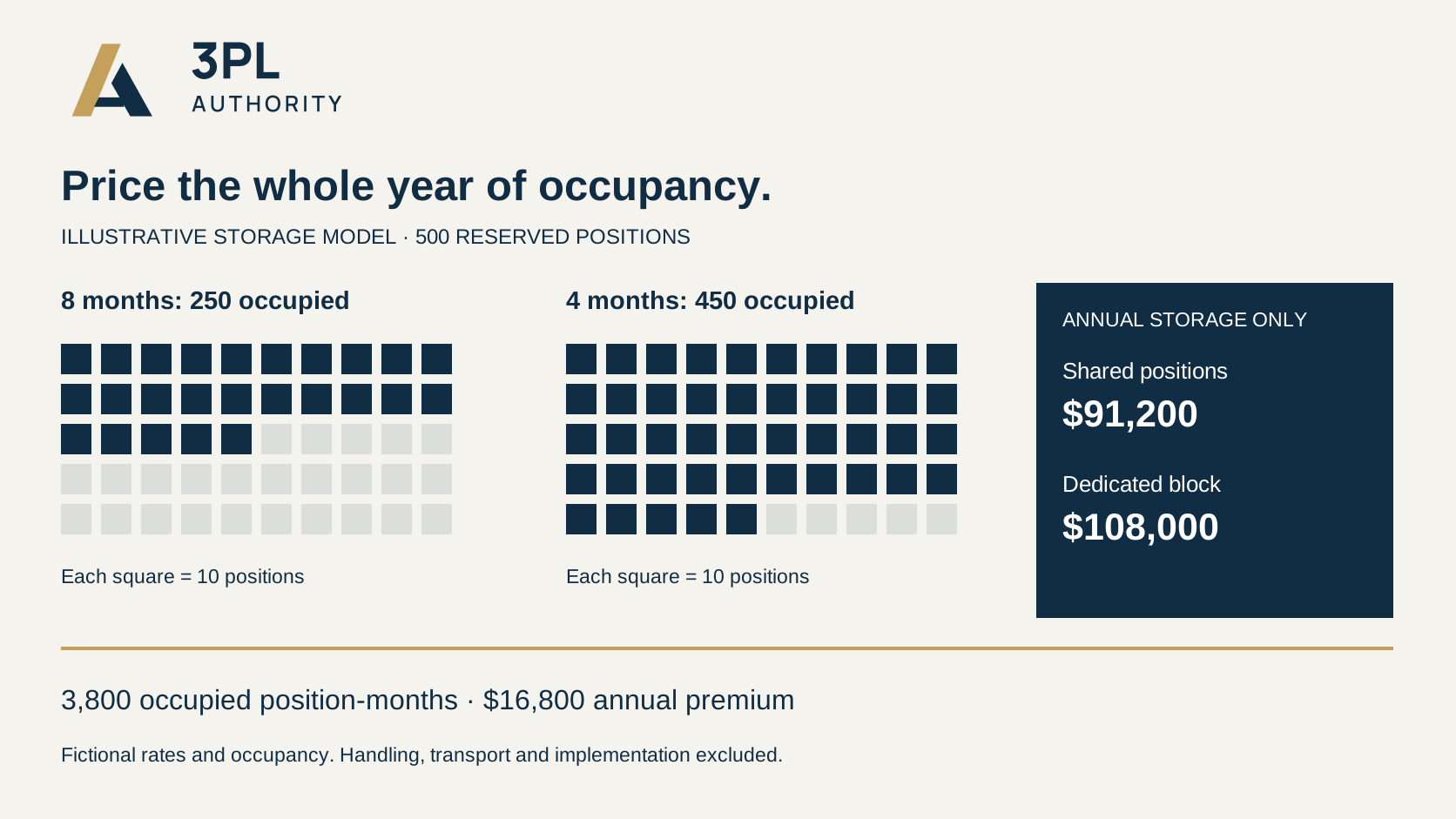
We calculated one fictional annual occupancy profile against two invented offers. All figures are illustrative US dollars, with no taxes or price escalation. Both offers are assumed to provide the same usable storage specification and measurement period. Handling, transport and implementation costs are excluded here and must be added separately.
| Assumption | Dedicated block | Shared positions |
|---|---|---|
| Monthly charge | $9,000 for up to 500 positions | $24 per occupied position |
| Eight quieter months | 250 occupied positions | 250 occupied positions |
| Four busier months | 450 occupied positions | 450 occupied positions |
The profile contains 3,800 position-months: eight times 250 plus four times 450. Shared storage costs $91,200; the dedicated block costs $108,000. The fixed block costs $16,800 more over this modeled year, even though it is cheaper during each 450-position month: $9,000 versus $10,800.
The simple monthly crossover is 375 occupied positions: $9,000 divided by $24. Average modeled occupancy is about 317, below that crossover. Choosing the dedicated arrangement on the basis of the busiest month would conceal the quieter months that determine the annual result.
Price the reason for exclusivity separately
That premium is not automatically waste. A brand might value a controlled work area, a particular access arrangement or a stable layout. But those benefits need a specification and evidence. Ask the provider which are included, which cost extra and how they would be delivered in a shared environment.
Do not assign a dollar benefit to fewer errors or faster dispatch without support. Instead, record the claimed operational improvement as unverified until a proposed pilot or relevant evidence can address it. Keep a separate column for costs that would change under either offer, such as dedicated supervision or movement between reserve storage and pick faces.
Test the boundary above the reservation
Our profile stays below 500 positions. A 550-position month would require another decision: overflow, a larger block, changed replenishment or a different arrangement. The example cannot establish the price or availability of those additional 50 positions. Ask for the overflow rule before accepting a fixed-area quote.
Use the same discipline for labor. A reserved position is not a promise that a particular order volume can be packed on a particular day. Require the service plan to state what happens when storage remains within its limit but orders exceed the agreed workload.
Choose dedicated space when its defined benefits and full-year economics support the commitment. Choose shared space when flexibility is more valuable and the provider can demonstrate the required controls. The label on the warehouse model should follow that analysis.
Further reading
Use our 3PL selection guide to structure the shortlist and fulfillment pricing guide to compare the scope of work.
Sources
Research accessed 2026-11-17.
- https://www.sba.gov/counseling/plan-your-business/
Research method and limitations
Calculated one synthetic 12-month occupancy profile against two hypothetical storage-only offers; derived crossover and annual premium. No provider pricing sample or service testing. All examples and proposed controls are original editorial desk analysis. No interviews, surveys, firsthand provider testing or provider responses occurred. Unknown provider capabilities remain unknown.