
A discounted fulfillment rate can look compelling until a new retailer, product or destination needs a different operating model. The selection question then changes: how much is the brand saving, and what work must it keep inside the arrangement to retain that saving?
Do not assume a forecast is a commitment, or that a volume commitment means every order must use one warehouse. Ask the candidate to describe the actual proposal. This is an operational comparison of proposed terms, not an interpretation of any particular contract.
Count the orders that might need another path
The SBA's business-planning guidance encourages examining demand, location and market segments. Apply that discipline to fulfillment: separate the demand you expect from the demand a particular operation is equipped to serve. A single monthly order total hides that difference.
Build a small routing ledger with an order group, its requirement, the proposed provider and the reason an alternative might be needed. Examples include retail orders requiring an untested workflow, unusually large products, and a destination outside the provider's useful service footprint. These are candidates for investigation, not automatic reasons to split the network.
Price the freedom using a deliberately narrow model
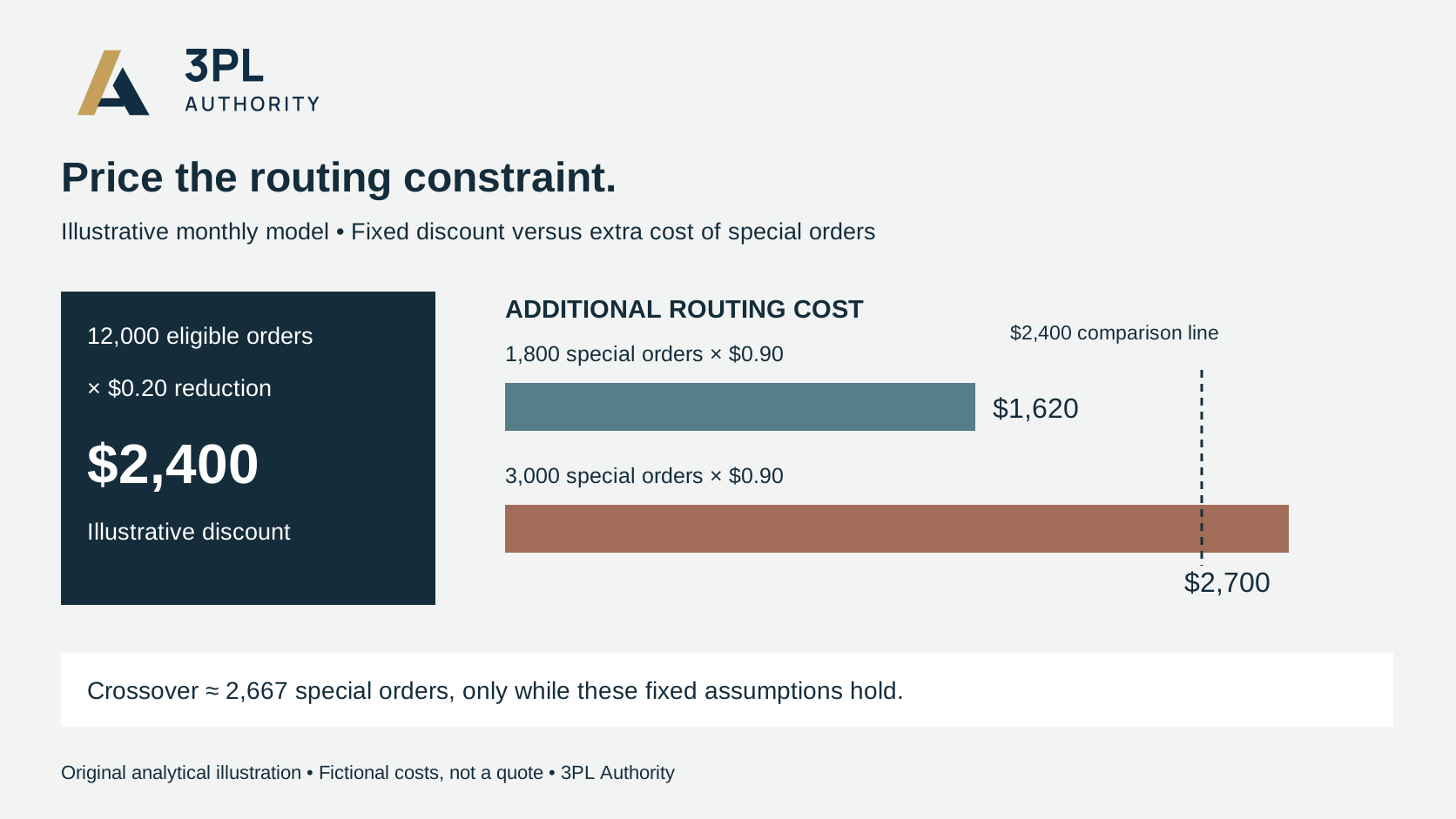
Consider a fictional monthly proposal offering a $0.20 reduction on 12,000 eligible orders if the agreed volume conditions are met. The discount is $2,400. Assume that routing a special group through the same arrangement costs $0.90 more per order than an available alternative, after comparable operating costs have been included.
At 1,800 special orders, that penalty is $1,620. The discount exceeds it by $780. At 3,000 special orders, the penalty becomes $2,700 and exceeds the discount by $300. Under these fixed assumptions, the crossover is about 2,667 special orders: $2,400 divided by $0.90.
This is our illustrative sensitivity calculation, not a quote or a finding about a provider. It excludes transition work, fixed fees, inventory duplication and service consequences. Its purpose is to expose a decision that the headline discount cannot settle. If eligible order volume changes, recalculate the discount too; do not preserve the $2,400 automatically.
Ask for exceptions that match real requirements
Use the ledger in the commercial discussion. Ask which orders count toward the proposed volume measure, which approved exceptions can go elsewhere, how returns and cancellations are treated, and when a shortfall is measured. Record the consequences of missing the measure in the provider's own written proposal.
Then ask operations to confirm that the permitted exception is executable. A contractual carve-out is of little use if the order feed still sends every order to the same place. Conversely, a software routing option does not establish that the commercial terms permit its use.
Select the arrangement you can explain under stress
Run the comparison with expected demand and a plausible change in channel mix. Have purchasing, operations and finance use the same counts. Obtain appropriate review of the actual terms before signing.
A volume-linked discount can be worthwhile. The stronger buying decision is one that remains understandable when the orders change, with exceptions and their costs visible before the brand becomes dependent on them.
Related reading
Sources
- SBA: Plan your business — accessed November 10, 2026.