
A fulfillment proposal promises to credit the handling fee when an eligible order ships late. That may be useful. It still tells you little about who will identify affected customers, authorize an upgrade or pay for the work required to restore the promised experience.
When selecting or renewing a 3PL, ask two questions: what remedy applies under the agreed terms, and what resources will get the affected orders back on track? Treating those as the same question can make a modest remedy look like a complete recovery plan.
Start with the customer obligation
The FTC's guidance for internet sellers addresses shipment promises, delay notices and refunds. It says sellers need a reasonable basis for a promised shipment period and describes the response when that period cannot be met. A warehouse credit does not tell the brand which customers require a notice or what those customers have agreed to. Review applicable obligations for the actual orders; this article does not interpret a particular contract.
The practical selection question is whether the 3PL can supply the affected-order list, current work state and credible revised shipment estimate early enough for your team to act. A credit report issued later answers a different operational need.
Work one fictional incident before valuing the promise
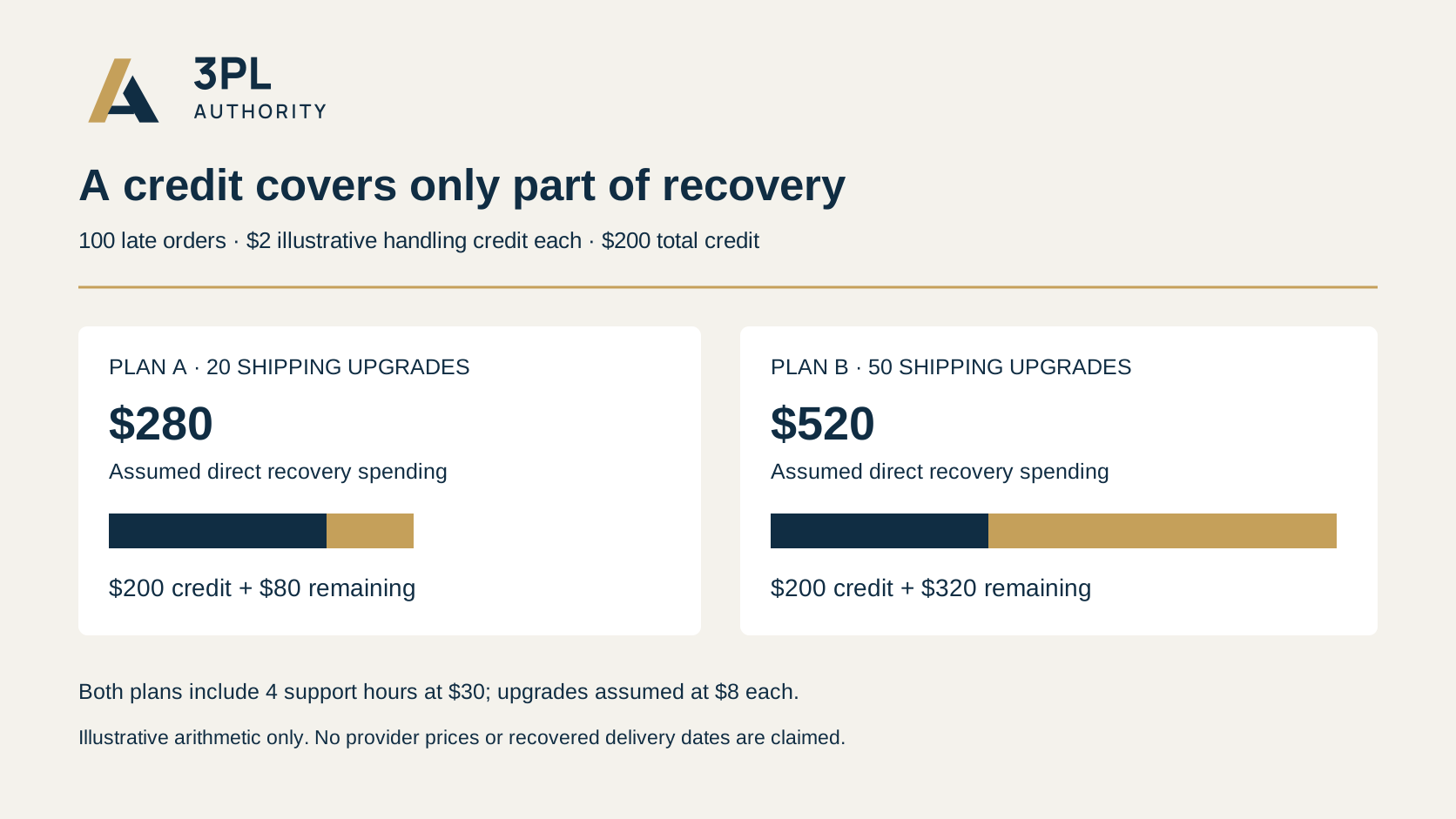
Our original desk scenario uses 100 late orders, a hypothetical $2 handling-fee credit per eligible order, and two possible recovery plans. No provider offers or customer incidents were sampled.
| Illustrative plan | Assumed direct recovery spending | Assumed credit | Spending remaining after credit |
|---|---|---|---|
| Upgrade 20 orders at $8; 4 support hours at $30 | $280 | $200 | $80 |
| Upgrade 50 orders at $8; 4 support hours at $30 | $520 | $200 | $320 |
The credit covers about 71% of the first plan and 38% of the second. These are arithmetic comparisons, not estimates of incident frequency or a promise that any upgrade recovers a delivery date. Lost margin, refunds, goodwill and future demand are excluded rather than assigned invented values.
Read the boundaries before comparing the headline
Ask which orders qualify, what evidence is needed, when a claim must be raised and whether the credit is automatic. Identify any cap and the exact fee it applies to. Record these as questions for the proposed agreement, not assumptions about standard industry terms.
Then ask who can approve recovery spending while eligibility is still being reviewed. Waiting for a billing decision may be incompatible with an urgent customer update. Conversely, upgrading every order without checking its actual deadline may spend money without improving the outcome.
Choose a recovery capability as well as a remedy
Use a short walkthrough: identify the affected cohort, assign customer communications, approve a feasible action, record its cost and reconcile any credit later. Ask the candidate to explain each handoff using its own process.
A larger credit is one commercial input. It should not outweigh evidence that a provider can surface exceptions, support decisions and execute the agreed recovery. The useful comparison is the residual exposure your business must manage after the remedy, including the work that never appears on a warehouse invoice.
Related reading
Sources
- Primary source 1 — accessed November 13, 2026.