
Two promises can compete for the same hour
A provider may offer a fast returns turnaround and a same-day outbound target. Evaluating those promises separately misses a practical question: are both plans using the same people and workstations?
A shared team is not automatically a problem. It may adapt well to changing demand. The selection issue is whether the provider can explain what happens when both queues need attention on the same day. Ask for the resource plan behind the commitments, including the work the brand must authorize before a return can finish.
Define what the returns team is finishing
Shopify’s documented return workflow distinguishes receipt and inspection from processing, and allows returns to be processed partially. That platform behavior helps explain why “returns received” is not the same workload measure as completed returns. It does not establish a warehouse’s labor requirement. Shopify return processing.
For a capacity discussion, define the completion point explicitly. Does the target include inspection, repacking, a stock update and an exception decision? If the warehouse waits for your team to approve disposition, identify that separate waiting period instead of assuming more warehouse labor will remove it.
Put both queues in one model
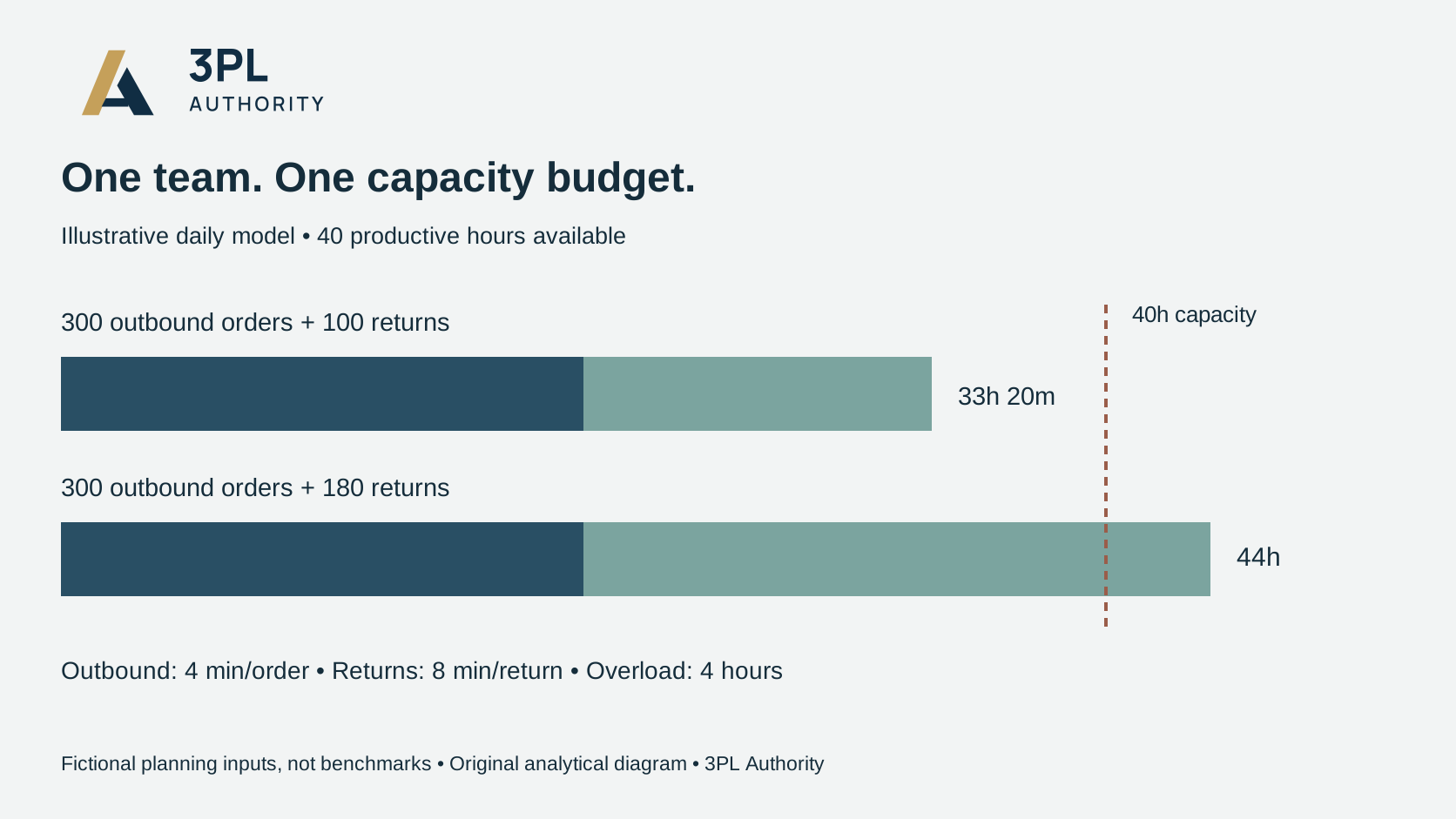
We constructed two demand cases for one fictional shared team. Assume 40 productive labor-hours are available that day, excluding breaks and other duties. Each outbound order consumes four minutes and each return consumes eight minutes. These are invented planning inputs, not industry productivity benchmarks.
At 300 outbound orders and 100 returns, outbound work requires 20 hours and returns require 13 hours 20 minutes. Total work is 33 hours 20 minutes, leaving six hours 40 minutes of modeled headroom.
At the same 300 outbound orders but 180 returns, returns require 24 hours. Total work reaches 44 hours, four above capacity. Calling both queues urgent does not create those four hours. If outbound gets its full 20 hours, the remaining 20 hours process 150 returns, leaving 30 unfinished under these assumptions.
Ask who resolves the conflict
Give candidates the second case and ask what changes: staffing, assignment, cutoff, scope or a service target. Request the person responsible for making that decision and the time at which the brand receives the revised forecast. A promise to add staff needs an explanation of training, stations and supervision; the arithmetic alone does not prove those resources exist.
Also ask whether difficult returns consume more time than the simple examples. Averages can conceal a small queue of labor-intensive products. Keep those cases visible in the forecast instead of allowing them to disappear into a total unit count.
Select a plan you can operate
Our exercise covers one team and two constructed demand cases, with no provider testing. Its value is the shared denominator: one available-hour budget for both commitments. Run the same model with a candidate’s documented assumptions and your own order mix.
A credible proposal should identify the constraint, the decision owner and the consequence for each queue. That is more useful than two attractive service promises that depend on the same uncommitted hour.
Related reading
Sources
- Shopify return processing — accessed November 11, 2026.