
A warehouse can hold enough stock to satisfy either of two sales channels and still disappoint both. The problem starts when a retailer's future commitment and a direct-to-consumer promotion draw from the same units without an agreed priority.
For a brand choosing a multichannel 3PL, “shared inventory” is an incomplete requirement. The useful question is which demand may consume which stock, at what point, and who can change that decision.
Separate a physical count from permission to sell
Shopify's inventory-state documentation distinguishes on-hand stock from available, committed and unavailable quantities. That distinction is a useful starting point, although it does not prove that a particular 3PL can protect inventory by channel. A matching total in two systems is not evidence that their allocation rules match.
Ask the provider to describe the decision in plain language: can an ordinary DTC order consume units set aside for a retail shipment? If yes, what authorizes that release? If no, what happens when the retail buyer reduces its requirement?
Work through a deliberately uncomfortable example
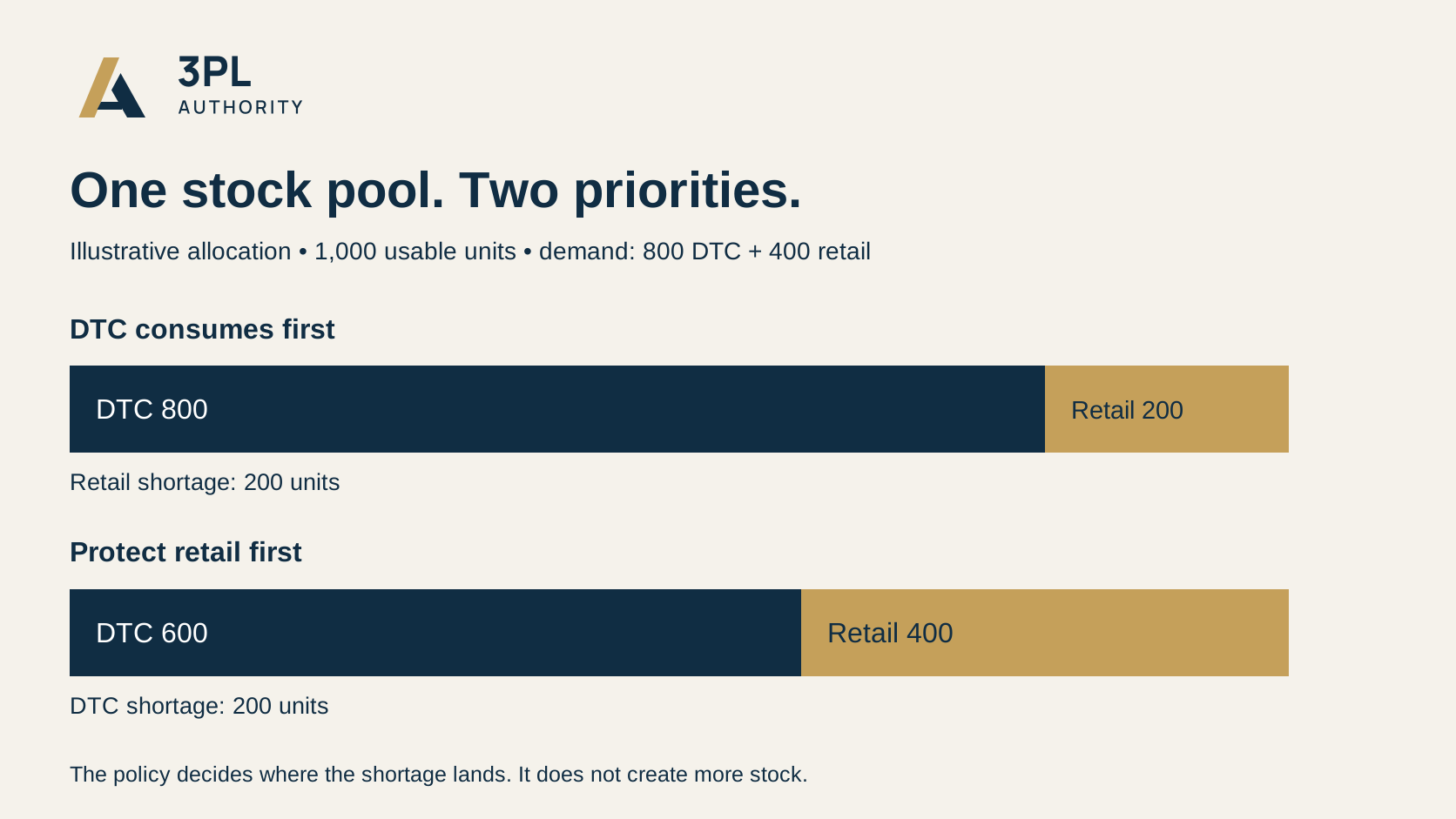
This is an illustrative scenario, not a forecast. A brand has 1,000 usable units. It wants 400 protected for a retail shipment. DTC demand arrives for 800 units before replenishment. Assume identical units, no returns and no incoming stock during the decision window.
| Policy | DTC units served | Retail units left | Unserved demand |
|---|---|---|---|
| DTC consumes the shared pool first | 800 | 200 | Retail short by 200 |
| Protect 400 for retail | 600 | 400 | DTC short by 200 |
Neither policy manufactures the missing 200 units. The choice determines where the shortage lands. A provider promising to “optimize everything” should still be able to explain this arithmetic and show whose priority governs it.
Now change one assumption: the retail requirement falls to 250 before DTC demand arrives. Retaining the original 400-unit protection unnecessarily withholds 150 units. Releasing those units makes 750 available to DTC, leaving a 50-unit DTC shortage. The release mechanism matters as much as the initial protection.
Evaluate four decisions, not a dashboard label
First, define the event that creates protection. Is it an approved purchase order, a planning entry or a manual instruction? A forecast should not silently acquire the authority of a firm commitment.
Second, identify the system that owns the rule. Require the implementation team to explain how a channel restriction reaches every order-entry path, including manual orders. A beautifully configured storefront rule is insufficient if another route bypasses it.
Third, name the person allowed to borrow protected units. The warehouse should execute an authorized policy, not negotiate commercial priorities between sales teams on a busy afternoon. Establish an escalation route for absence and disagreement.
Fourth, define expiration and release. A canceled retail order should trigger review of its protection. Do not rely on somebody remembering an old email after inventory has become scarce.
Make the demonstration decide the shortlist
Give each candidate the same two scenarios above. Ask for a demonstration or a documented configuration walkthrough, with the initial quantities, attempted orders, rejection or hold behavior, and subsequent release visible. This is a proposed evaluation, not a test we have performed.
Record native capability, custom work and manual intervention separately. Manual approval may be perfectly appropriate for a few high-value retail commitments; it becomes less attractive when hundreds of allocations change daily. Price the required operating effort rather than assuming automation is always preferable.
Choose the provider whose controls fit the commercial policy your team can actually govern. The right multichannel design makes a shortage decision explicit before an order promises inventory that another customer already expects.
Related reading
- DTC and retail fulfillment: compare two operating models
- One 3PL for retail and DTC—or a specialist for each?
Sources
- Shopify: Inventory states — accessed November 4, 2026.