
A stable operation still needs a way to change
A promotion is a poor moment to discover that a warehouse updated your routing rule without anyone on your team knowing. Yet a blanket ban can also leave a broken rule in place. When selecting a 3PL, ask how it separates necessary repairs from optional improvements during a sensitive selling period.
NIST's system change-control guidance includes testing and documenting changes before implementation. It is an information-system control framework, not a certification of warehouse performance. The useful buyer question is how that discipline appears in the order flow you will actually use. NIST SP 800-53, CM-3(2).
Put three proposed changes through the same gate
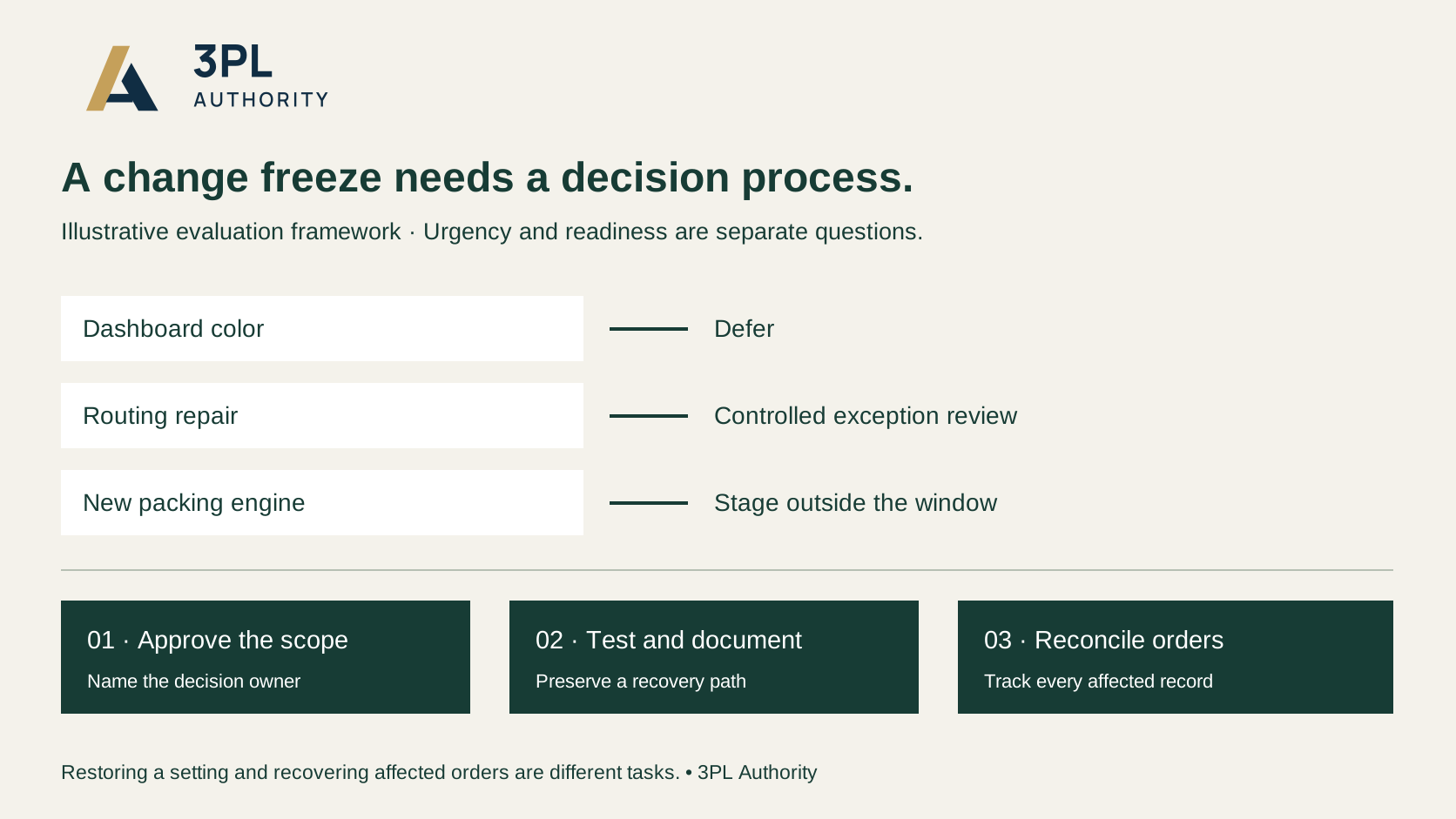
We constructed a desk exercise with three hypothetical requests. This is a proposed evaluation tool; no provider was tested. Each request is assessed against customer impact, reversibility and the evidence needed to release it.
| Request | Proposed decision | Evidence to request |
|---|---|---|
| Change a dashboard color | Defer during the protected window | Confirmation it has no operational dependency |
| Correct a routing rule rejecting valid orders | Consider a controlled exception | Reproducible failure, limited test and affected-order list |
| Introduce a new packing recommendation engine | Stage outside the window unless necessary | Representative order tests, approval and recovery plan |
The conclusion is not that every urgent change should proceed. Urgency and readiness are separate questions. An urgent repair without a reliable recovery path may require temporarily holding the affected orders instead.
Rollback has two parts
Ask the provider to distinguish restoring the previous configuration from repairing orders already processed under the new one. Reverting software will not, by itself, recall a carton already tendered to a carrier. The recovery record should identify which orders need review, who owns that review and how duplicate release is prevented.
Consider an illustrative routing correction that affects 40 waiting orders. Before release, save their identifiers and current states. After the change, reconcile those same 40 records. A report that the queue is now empty does not establish whether each order shipped once, moved to another hold or disappeared from the report.
Make the freeze a service agreement
Agree on the protected dates and time zone, covered integrations and operational rules, approval contacts, and emergency escalation route. Include brand-side changes: a new bundle or altered shipping promise can disturb the operation even when the warehouse changes nothing.
During evaluation, ask for a redacted change record showing the request, decision, test, release time and follow-up. Treat an unavailable example as an evidence gap, not automatic proof of poor control. Request a tabletop demonstration instead.
Choose the provider whose process makes consequences visible. A confident promise that nothing will change tells you less than a clear explanation of what happens when something must.
Related reading
Sources
- Primary source — accessed November 9, 2026.