
Packaging can outlast the warehouse relationship
A brand can move its finished goods and still be unable to reproduce the package customers expect. The missing piece may be the approved artwork, an insert specification, a supplier contact or simply agreement about who owns the unused cartons.
Put packaging procurement into the 3PL selection brief before comparing unit prices. Ask who places the purchase order, who funds it, where title is documented, and which files the brand can take to another operation. These are questions to resolve in the actual agreement, not rights to assume from whose logo appears on the carton.
Compare the arrangement at two moments
First assess the normal operating month: purchase quantities, lead times, reorder approval and storage. Then assess a move: count the unused materials, determine their condition, confirm release arrangements and ask whether the receiving warehouse can use them.
We constructed two fictional purchasing arrangements to isolate transferability. Neither represents a provider quote. The model separates recurring savings from a one-time transition cost; the SBA’s break-even calculator provides background on separating fixed and variable costs. Our calculation below is a cost comparison, not a business-profit forecast.
| Illustrative input | Provider-managed arrangement | Brand-controlled arrangement |
|---|---|---|
| Packaging purchased | 20,000 units | 20,000 units |
| Assumed purchase price | $0.90 each | $1.00 each |
| Initial purchase total | $18,000 | $20,000 |
| Assumed transition expense | $3,000 | $600 |
| Combined modeled cost | $21,000 | $20,600 |
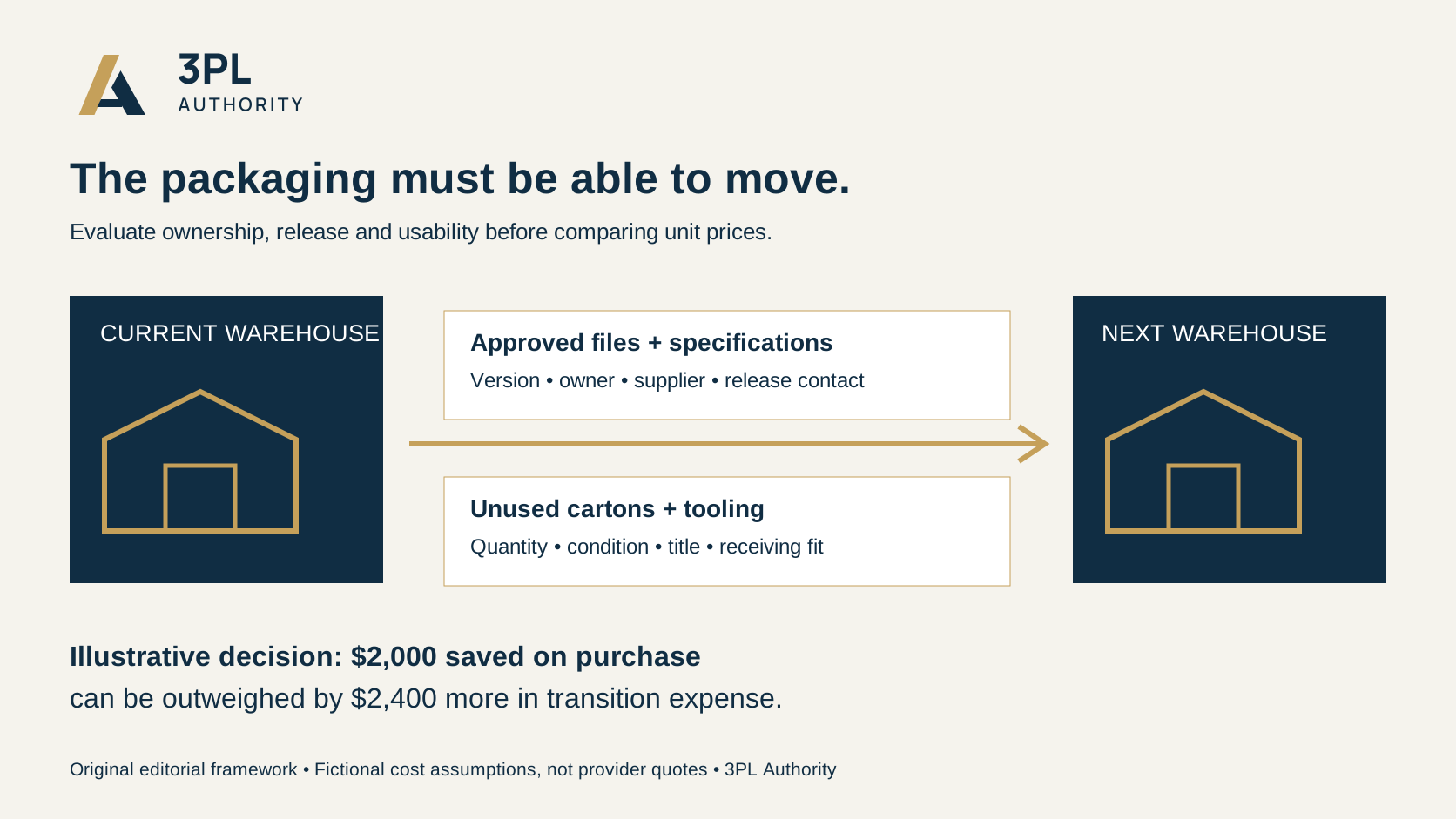
The initial $2,000 saving is smaller than the $2,400 difference in transition expense. In this constructed case, the brand-controlled option ends $400 lower. If no transition occurs, the initial purchase comparison still favors the cheaper arrangement. We have not assigned a probability to a move.
Find out what the transition expense contains
The $3,000 and $600 are assumptions to replace with evidence. Separate release and handling, freight, new tooling or artwork setup, and any replacement stock needed while the next supplier starts. Do not charge for the same unused packaging twice: a payment already included in the purchase total is not a new exit expense merely because the inventory moves.
A useful sensitivity check asks how much additional transition expense would erase the purchasing saving. Here it is $2,000. That gives the buyer a negotiation question: can the parties document a transfer process whose incremental cost stays below that amount? It does not establish a universal target.
Request a portable packaging file
For every custom material, record the specification version, owner of the approved files, supplier, remaining quantity, reorder lead time and release contact. Ask whether tooling belongs to the brand, the supplier or another party. Have the appropriate commercial reviewer resolve unclear terms.
Finally, ask the proposed receiving 3PL to review the physical materials before committing to transfer them. A carton that is owned by the brand can still be unsuitable for a different packing process. Choose the procurement arrangement with both continuity and total cost in view; the smallest unit price is only one part of that decision.
Further reading
Sources
- SBA: Break-even point calculator — accessed 2026-11-05.