
A fixed onboarding fee can look reassuring while the difficult work remains outside its definition. A brand may have a price for account setup without a price for repairing product data, mapping a retailer file or repeating an acceptance run after a change.
Before approving a 3PL launch, ask what the implementation price actually closes. A budget is useful only if the team can tell which work it buys and what event would create another charge.
Make uncertainty visible before adding a percentage
The SBA's business-planning guidance distinguishes one-time and monthly expenses and recommends estimating costs that are less certain. Apply that distinction to the launch: keep temporary setup work separate from the continuing operating bill. The scenario below is our own budgeting exercise, not SBA pricing guidance or a provider quote.
Create an open-scope register with the deliverable, missing input, decision owner, cost assumption and deadline. “Integration” is too broad. “Map the retailer's second order format after receiving an approved example” is something a team can assign and price.
A three-case launch budget
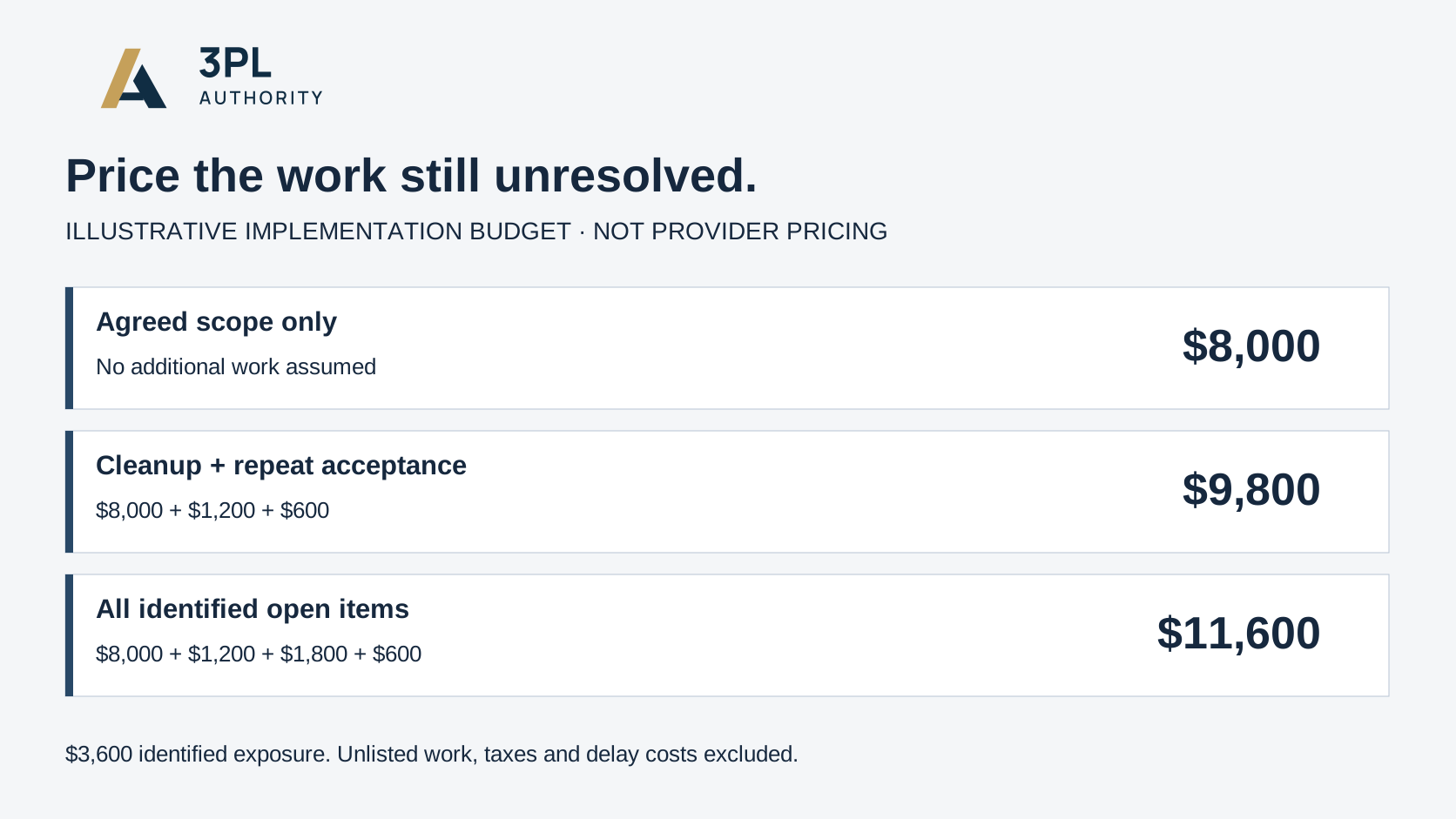
Our fictional project has $8,000 of agreed implementation work. Three unresolved items could add cost: product-data cleanup at $1,200, a retailer mapping change at $1,800 and a repeat acceptance run at $600. We evaluate three deliberately selected combinations; we assign no probabilities.
| Case | Assumed additional work | Launch total |
|---|---|---|
| Scope resolved without extra work | None | $8,000 |
| Data issue requires cleanup and another run | $1,200 + $600 | $9,800 |
| All three identified items occur | $1,200 + $1,800 + $600 | $11,600 |
The identified exposure spans $3,600. That is a planning envelope for these items, not a maximum project price: unlisted issues, taxes and schedule effects are excluded. Do not describe the middle case as the most likely outcome without evidence.
Resolve a dependency, then change the budget
Suppose the brand supplies clean product data before the agreed deadline and both teams accept it. That may remove the cleanup item, but it does not automatically remove the repeat test. A retailer mapping change could still require another run. Track the dependency rather than deleting both costs because they appeared together in one scenario.
The same discipline applies to ownership. Brand staff time may not appear on the 3PL invoice, yet it can still determine whether a launch is feasible. Record required people and dates alongside cash charges without inventing an hourly value for every internal task.
Use the register in the selection decision
Give shortlisted providers the same unresolved items and request an explicit treatment: included, separately priced, awaiting information or outside scope. Ask what constitutes acceptance and who can authorize a change. A provider that identifies an uncertainty has not necessarily offered a worse deal than one that leaves it unstated.
Before release, reconcile the register to the approved scope. Open items should have owners and a consequence for the launch decision. The practical outcome is a budget the operating team can explain when work changes, with fewer assumptions hidden inside one comforting number.
Further reading
Use our 3PL selection guide to structure your shortlist and fulfillment pricing guide to check the full service scope.
Sources
Research accessed 2026-11-15.
- https://www.sba.gov/counseling/plan-your-business/
Research method and limitations
Constructed three fictional implementation-cost cases from one base and three explicit add-ons; recalculated totals and identified dependent retest costs. Not a quote, forecast, guaranteed ceiling or legal interpretation of a contract. Unlisted work, taxes and delay costs excluded. No firsthand provider testing, interviews, surveys or outreach occurred.