
A fulfillment provider says it can process 1,000 orders a day. That sounds reassuring until your store also releases 1,000 new orders every day. The warehouse may be working at its stated rate while the old backlog stays exactly where it was.
For a buyer comparing 3PL recovery plans, ask for a queue forecast as well as a throughput figure. The decision is whether the operation can recover the promise it has already missed while serving the demand still coming in.
Give the queue a precise boundary
Decide what counts as unfinished work. Shopify’s individual fulfillment guidance distinguishes fulfilling an order from the subsequent packaging and carrier handoff. A platform status alone should therefore not define physical clearance in your recovery exercise. Agree the operational endpoint and reconcile it to carrier handoff evidence.
Separate orders awaiting inventory or customer approval from orders the warehouse can work now. Both groups matter to customers, but adding labor will not solve the same constraint in each. Preserve the excluded groups in a separate report; removing them from the executable queue should not make them disappear from the service discussion.
Calculate the spare capacity
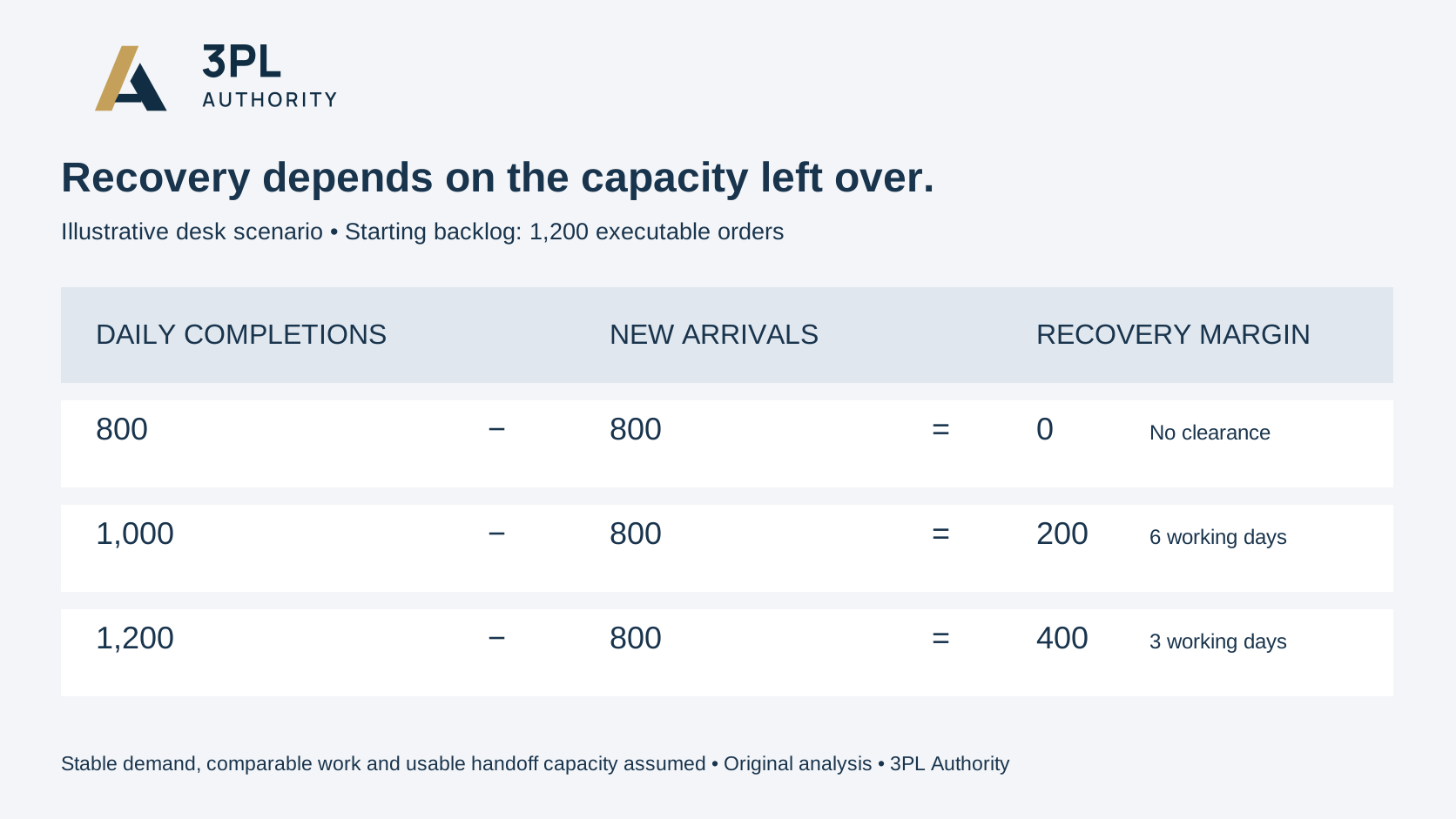
We constructed this simplified desk exercise using a starting queue of 1,200 executable orders and 800 new executable orders each working day. The three outputs below are hypothetical sustained completions at the agreed endpoint, with comparable order complexity.
| Daily completions | Daily queue reduction | Working days to clear the starting queue |
|---|---|---|
| 800 | 0 | Does not clear |
| 1,000 | 200 | 6 |
| 1,200 | 400 | 3 |
The calculation is starting backlog divided by completions minus new arrivals. It is useful only when completions exceed arrivals. A negative difference means the queue grows. Fractions of a day should be rounded up when planning whole operating days.
This is not a forecast of any provider’s performance. It assumes stable demand, available stock, comparable orders and usable carrier capacity. Replace each assumption with evidence before making a customer promise.
Ask which part of capacity is actually yours
A building-wide number may include other clients, retail pallet work or orders requiring fewer touches. Request an allocated recovery commitment for your order mix, the staffing period supporting it and the pickup plan. Ask what happens if new arrivals rise to 950 in the middle scenario: the daily recovery margin falls to 50, and clearing 1,200 orders would take 24 working days under those assumptions.
That sensitivity is the useful finding. A modest demand change can consume most of the recovery margin even when the warehouse’s output stays constant.
Protect older orders while the total shrinks
A falling total does not show whether the oldest orders are moving. Request an age-band view and the explicit prioritization rule alongside the daily queue arithmetic. Ask for the count of orders that have crossed their agreed dispatch deadline and the reason each remaining group cannot move.
Select the recovery plan that exposes its constraints and provides a way to verify progress. A credible commitment states the starting population, new-work assumption, completion endpoint, allocated capacity and review date. If one of those is missing, the impressive throughput number is not yet a usable recovery promise.
Related reading
Sources
- Shopify: Fulfilling your own orders individually — accessed November 12, 2026.