
Buy an outcome you can count
A warehouse demonstration can make an automation investment look decisive. Carts move quickly, a picker walks less, and a dashboard reports more completed picks. For a brand selecting a 3PL, the relevant question is more specific: how many of its orders can leave correctly before the collection window?
Treat a picking improvement as a hypothesis about that outcome. Ask the provider to identify the next operation, the work waiting there and the labor or equipment required to complete it. This turns a technology conversation into a capacity discussion that can be checked against your order mix.
Keep three clocks separate
The Lean Enterprise Institute distinguishes cycle time, processing time and overall lead time. A faster operation is not the same measurement as a shorter journey through the entire process. Its definition of effective machine cycle time also includes loading, unloading and an allowance for changeovers.
Apply that distinction when reviewing a proposal. A machine demonstration may exclude replenishment, carton changes, exception handling or the wait for carrier collection. Ask what the quoted number includes before comparing it with another warehouse’s finished-order rate.
Work through a deliberately simple capacity model
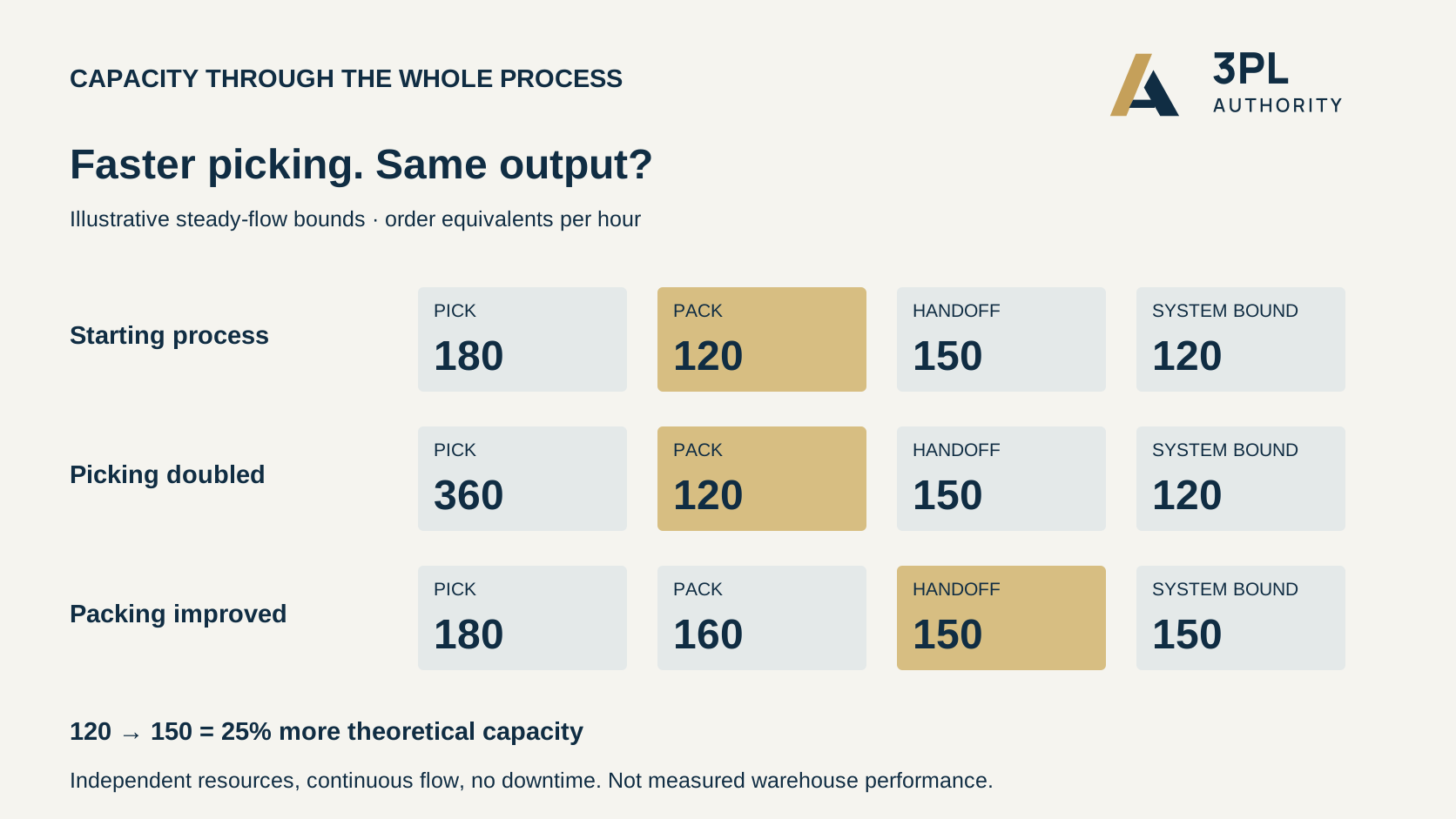
We calculated three fictional scenarios using the same order equivalent at every stage. Assume continuous work, independent resources, sufficient inventory and no downtime. Under those assumptions, the lowest stage capacity limits steady output. These are theoretical bounds, not warehouse test results.
| Illustrative configuration | Pick capacity/hour | Pack capacity/hour | Handoff capacity/hour | System bound/hour |
|---|---|---|---|---|
| Starting process | 180 | 120 | 150 | 120 |
| Picking doubled | 360 | 120 | 150 | 120 |
| Packing improved instead | 180 | 160 | 150 | 150 |
Doubling picking adds no system capacity in the second case. Raising packing capacity in the third raises the bound from 120 to 150, a 25% increase. Handoff then becomes the limiting stage. The calculation does not prove that investing in packing is always better; it shows why the location of the constraint matters.
Real operations also have bursts, breaks, shared workers and different order sizes. Do not multiply the hourly bound by an entire shift and call the result a service commitment. Ask the provider to replace the assumptions with an observed operating window and a defined product mix.
Put the claim into the selection process
Request a before-and-after plan with four fields: eligible orders, the changed step, downstream capacity and the finished-order measure. A fragile multi-item order may follow a different route from a single boxed unit. Keep those groups visible instead of blending them into one attractive average.
Then ask where the faster process sends exceptions. If an unreadable label or missing component exits into a manual queue, that queue needs an owner and capacity too. A successful demonstration on easy orders does not establish how the exceptions will clear.
Make the pilot answer the investment question
For a proposed pilot, agree on the order mix, observation period and departure evidence in advance. Record work waiting at each stage alongside completed shipments. Include errors and rework in the review rather than rewarding speed that creates another task later.
Choose the provider whose improvement addresses your actual constraint and can be supported through the downstream handoff. Automation can be useful evidence of capability. The buying decision still rests on the complete order path.
Further reading
Sources
- Lean Enterprise Institute: Cycle Time — accessed 2026-11-01.