
Start with the task, not the demonstration
A fulfillment platform can produce an impressive demonstration in a few minutes. A buyer still needs to decide whether the feature improves the work their own team performs every week. The relevant unit is a completed, checked operating task—not a generated answer or a button click.
Choose a narrow starting use case, such as preparing a draft receiving request from approved information. Define the beginning and end, who checks the result, and what happens when the tool cannot finish. Do not combine reporting, order changes and inventory decisions into one undifferentiated claim about automation.
The NIST AI Risk Management Framework is voluntary guidance for incorporating trustworthiness into AI design, use and evaluation. It is not a certification of a particular fulfillment feature or a promise of economic benefit. Our worksheet adds a buyer-side cost test to that broader evaluation context.
Calculate the net work change
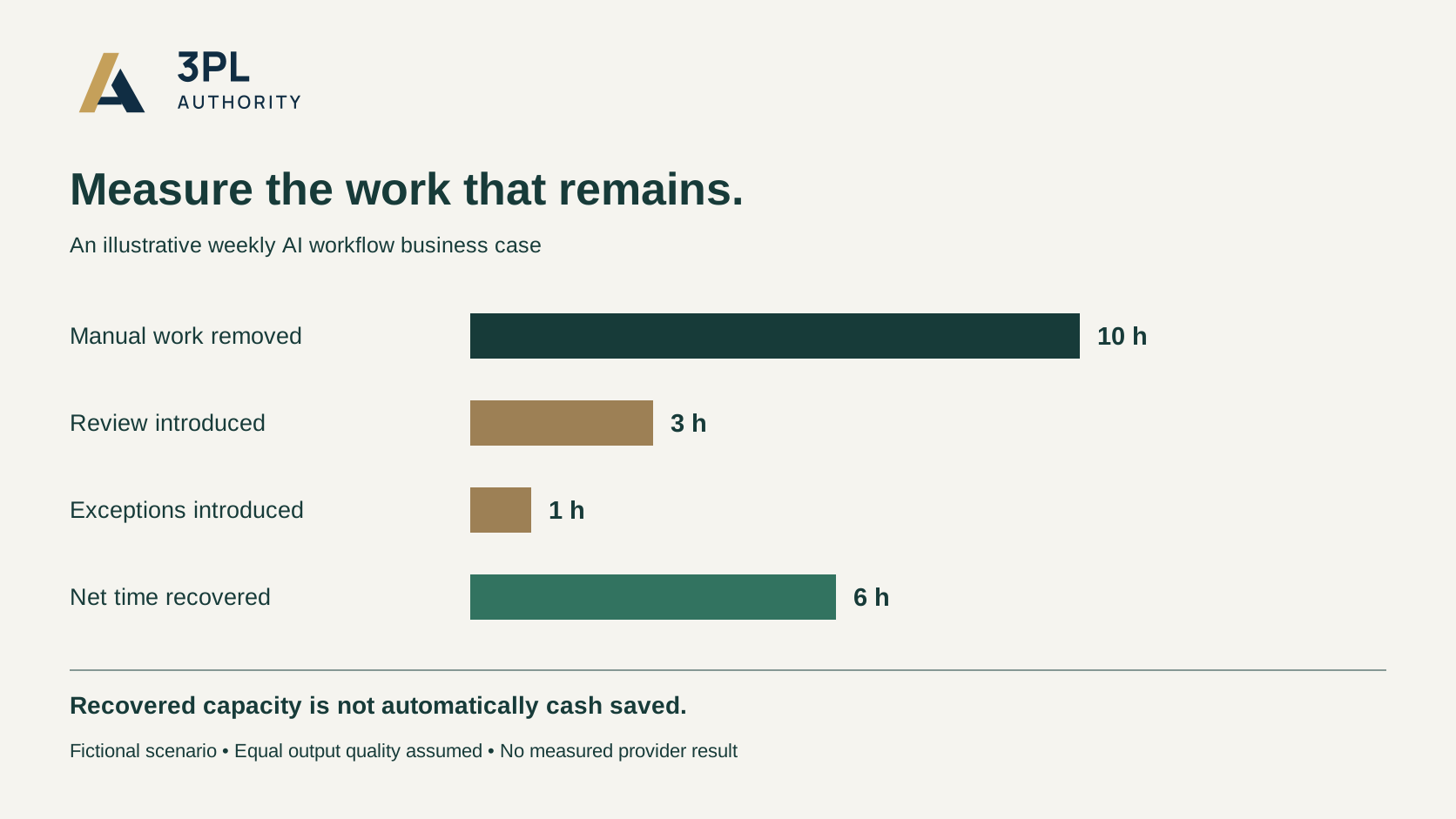
We constructed one fictional workflow with ten hours of weekly manual work. The proposed tool removes those ten hours but introduces three hours of review and one hour of exception handling. Assume those added tasks are distinct and that the same output quality is achieved.
| Illustrative weekly component | Hours |
|---|---|
| Manual work removed | 10 |
| Review introduced | 3 |
| Exception handling introduced | 1 |
| Net staff time recovered | 6 |
The net benefit is six hours, not ten. Over an explicitly four-week comparison period, that is twenty-four hours. At an invented $35 per hour, the time has an assigned value of $840. Subtract an illustrative $500 fee and the modeled difference is $340.
That $340 is not automatically cash saved. If payroll and contractor invoices remain unchanged, the business has recovered capacity while adding a $500 cash expense. The economic case may still work if those hours relieve a real bottleneck, but the proposal needs to name that use. If paid hours genuinely decline, document the avoidable expense rather than valuing every salaried hour as removable.
Keep quality and volume comparable
The model contains no measured productivity result. Before using it in a purchase decision, collect a baseline for a defined task set and compare equivalent outputs. Include routine cases, missing fields and conflicting data. Count time spent correcting mistakes outside the tool as part of the new workflow.
Ask who can authorize changes, which actions need approval and where completed actions are recorded. A read-only report and an instruction that changes an order have different consequences. Test the intended permissions and escalation route, not merely the interface shown in the sales call.
Identify costs that survive the pilot
Request the ongoing fee, usage limits, training effort and support arrangement. A free trial is not evidence of the later price. Also identify what work returns to the team when the feature is unavailable. Avoid assuming that someone else will absorb the exception queue without adding effort or cost.
For each finalist, keep three separate conclusions: observed task performance, estimated recovered capacity and expected cash impact. Mark anything unmeasured as unknown. This prevents a polished demo from being scored as a verified operating saving.
Buy the benefit you can use
A suitable feature may help a small team manage more volume without immediately reducing expenditure. Another may genuinely remove a paid manual service. Either can be a sound reason to buy, but they are different cases. Ask the provider to support the task-level claim, then make the commercial decision from your own operating constraints.
Related reading
Sources
- Source 1 — accessed 2026-11-03.